Geological Time


Geological Time
back to Contents of Entire Course...
Relative and Absolute Age
Principles of Stratigraphy
Breaks in the Stratigraphic Record
Angular Unconformity
Disconformity
Nonconformity
Variation of unconformities
Stratigraphic Classification
The Geologic Column
Absolute Geologic Time
Potassium - Argon (K-Ar) Dating
Radiocarbon (14C) Dating
Absolute Dating and Geologic
Time Scale
The Age of the Earth
adapted to HTML from lecture notes of Prof. Stephen A. Nelson Tulane
University
Relative and Absolute Age
In order to understand how geologists deal with time we first need to understand the concepts of relative age and absolute age.
To better understand these concepts, let's look at an archeological example: Imagine we are a group of archeologists studying two different trash pits recently discovered. By carefully digging, we have found that each trash pit shows a sequence of layers. Although the types of trash in each pit is quite variable, each layer has a distinctive kind of trash that distinguishes it from other layers in the pits.
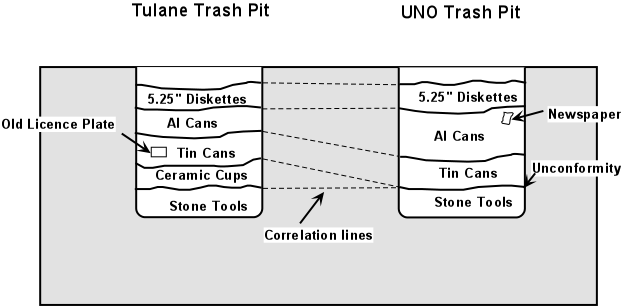
What can we say and learn from these excavations?
- Relative age of trash layers - Because of the shape of the pits the oldest layers of trash occur below younger layers i.e. the inhabitants of the area likely deposited the trash by throwing it in from the top, eventually filling the pits. Thus the relative age of the trash layers is, in order from youngest to oldest.:
- 5.25" Disk Layer - Youngest
- Al Cans Layer
- Tin Cans Layer
- Ceramic Cups Layer
- Stone Tools Layer - Oldest
Thus we do not know the absolute age of any given layer.
- The civilizations that deposited the trash had a culture and industrial capabilities that evolved through time. The oldest inhabitants used primitive stone tools, later inhabitants used cups made of ceramics, even later inhabitants eventually used tin cans and then changed to Aluminum cans, and then they developed a technology that used computers.
- Similar cultures must have existed in both areas and lived at the same time. Thus we can make correlation's between the layers found at the different sites, by reasoning that layers containing similar discarded items (artifacts) were deposited during the same time period.
- Because the Ceramic Cups layer is found at the Tulane site, but not at the UNO site, the civilization that produced the Ceramic cups probably did not live in the UNO area. Thus, we can recognize a hiatus, or break in the depositional sequence at the UNO site. The surface marking in the break in deposition would be called an unconformity in geologic terms, and represents time missing from the depositional record.
- The trash pits contain some clues to absolute age:
- The Tulane trash pit has an old license plate in the Tin Cans layer. This plate shows a date of 1950, thus the Tin Cans layer is about 48 years old.
- The UNO trash pit has an old newspaper in the Al Cans layer. The date on the newspaper is Oct. 1, 1978. Thus the Al Cans layer is about 20 years old.
In geology, we use similar principles to determine relative ages, correlations, and absolute ages.
- Relative ages - Principles of Stratigraphy
- Correlations - Fossils, key beds, physical criteria
- Absolute ages - Radiometric dating
Principles of Stratigraphy
Stratigraphy = the study of strata (layers) in the Earth's crust.
Laws of Stratigraphy
Original Horizontality - sedimentary strata are deposited in layers that are horizontal or nearly horizontal, parallel to or nearly parallel to the Earth's surface. Thus rocks that we now see inclined or folded have been disturbed since their original deposition.
Stratigraphic Superposition - Because of Earth's gravity, deposition of sediment will occur depositing older layers first followed by successively younger layers. Thus, in a sequence of layers that have not been overturned by a later deformational event, the oldest layers will be on the bottom. This is the same principle used to determine relative age in the trash pits discussed previously. In fact, sedimentary rocks are, in a sense, trash from the Earth's surface deposited in basins.
Breaks in the Stratigraphic Record
Because the Earth's crust is continually changing, i.e due to uplift, subsidence, and deformation, erosion is acting in some places and deposition of sediment is occurring in other places. When sediment is not being deposited, or when erosion is removing previously deposited sediment, there will not be a continuous record of sedimentation preserved in the rocks. We call such a break in the stratigraphic record a hiatus (a hiatus was identified in our trash pit example by the non-occurrence of the Ceramic Cups layer at the UNO site). When we find evidence of a hiatus in the stratigraphic record we call it an unconformity. An unconformity is a surface of erosion or non-deposition. Three types of unconformities are recognized.
Angular Unconformity
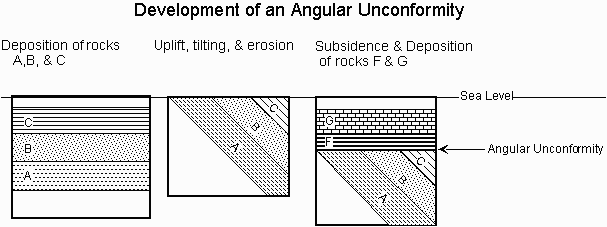
Because of the Laws of Stratigraphy, if we see a cross section like this in a road cut or canyon wall where we can recognize an angular unconformity, then we know the geologic history or sequence of events that must have occurred in the area to produce the angular unconformity. Angular unconformities are easy to recognize in the field because of the angular relationship of layers that were originally deposited horizontally
Disconformity
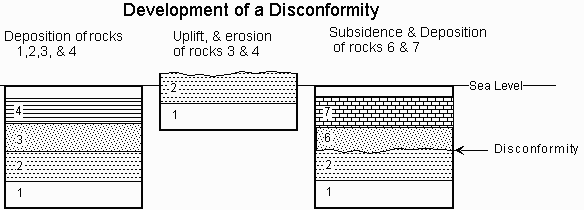
Disconformities (called parallel unconformities in your lab book) are much harder to recognize in the field, because often there is no angular relationship between sets of layers. Disconformities are usually recognized by correlating from one area to another and finding that some strata is missing in one of the areas. The unconformity recognized in the UNO trash pit is a disconformity.
Nonconformity
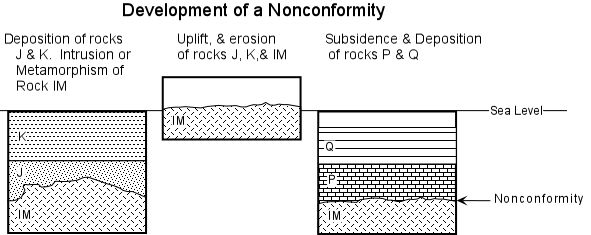
Nonconformities occur where rocks that formed deep in the Earth, such as intrusive igneous rocks or metamorphic rocks, are overlain by sedimentary rocks formed at the Earth's surface. The nonconformity can only occur if all of the rocks overlying the metamorphic or intrusive igneous rocks have been removed by erosion.
Variation of unconformities
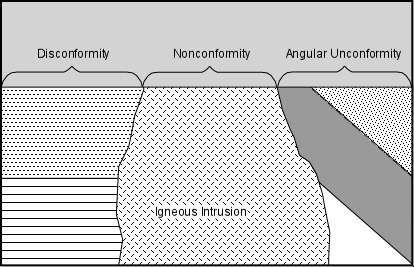
The nature of an unconformity can change with distance. Notice how if we are only examining a small area in the figure above, we would determine a different type of unconformity at each location, yet the unconformity itself was caused by the same erosional event.
Two types of stratigraphic classification are used,
one based on physical characteristics or material properties of the rocks - Rock Stratigraphic Units, and the other based on the time over which the material was formed - Time Stratigraphic Units.Rock Stratigraphic Units
Distinctive bodies of rocks that differ from the rocks above and below in the general characteristics. The basic unit is a formation.
Time Stratigraphic Units
A bodies of rocks that were deposited during the same geologic time interval. The basic unit is a period.
Correlation of Rock Units
In order for rock units to be correlated over wide areas, they must be determined to be equivalent. Determination of equivalence is based on:
The Geologic Column
Over the past 150 years detailed studies of rocks throughout the
world based on stratigraphic, paleontologic, and correlation studies have
allowed geologists to correlate rock units throughout the world and break
them into time stratigraphic units. The result is the geologic
column, which breaks relative geologic time into units of known relative
age. Note that the geologic column was established and fairly well
known before geologists had a means of determining absolute ages.
Thus in the geologic column shown, the absolute ages in the far right-hand
column were not known until recently.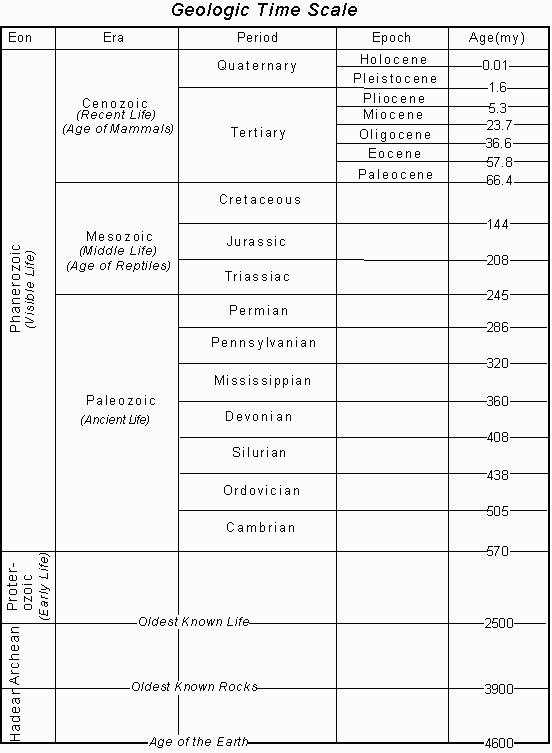
Absolute Geologic Time
Although geologists can easily establish relative ages of rocks based on the principles of stratigraphy, knowing how much time a geologic Eon, Era, Period, or Epoch represents is a more difficult problem without having knowledge of absolute ages of rocks. In the early years of geology, many attempts were made to establish some measure of absolute geologic time.
Age of Earth estimated on the basis of how long it would take the oceans to obtain their present salt content. Assumes that we know the rate at which the salts (Na, Cl, Ca, and CO3 ions) are input into the oceans by rivers, and assumes that we know the rate at which these salts are removed by chemical precipitation. Calculations in 1889 gave estimate for the age of the Earth of 90 million years.
Age of Earth estimated from time required to cool from an initially molten state. Assumptions include, the initial temperature of the Earth when it formed, the present temperature throughout the interior of the Earth, and that there are no internal sources of heat. Calculations gave estimate of 100 million years for the age of the Earth.
In 1896 radioactivity was discovered, and it was soon learned that radioactive decay occurs at a constant rate throughout time. With this discovery, Radiometric dating techniques became possible, and gave us a means of measuring absolute geologic time.
Radiometric Dating
Radiometric dating relies on the fact that there are different types of isotopes.
Radioactive Isotopes - isotopes (parent isotopes) that spontaneously decay at a constant rate to another isotope.
Radiogenic Isotopes - isotopes that are formed by radioactive decay (daughter isotopes).
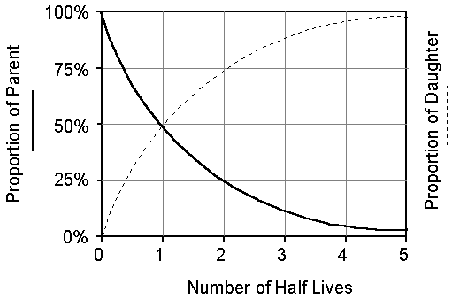
The rate at which radioactive isotopes decay is often stated as the half-life of the isotope (t1/2). The half-life is the amount of time it takes for one half of the initial amount of the parent, radioactive isotope, to decay to the daughter isotope. Thus, if we start out with 1 gram of the parent isotope, after the passage of 1 half-life there will be 0.5 gram of the parent isotope left.After the passage of two half-lives only 0.25 gram will remain, and after 3 half lives only 0.125 will remain etc.
Some examples of isotope systems used to date geologic materials.
| Parent | Daughter | t1/2 | Useful Range | Type of Material |
|---|---|---|---|---|
| 238U | 206Pb | 4.5 b.y | >10 million years | Igneous Rocks and Minerals |
| 235U | 207Pb | 710 m.y | ||
| 232Th | 208Pb | 14 b.y | ||
| 40K | 40Ar & 40Ca | 1.3 b.y | >10,000 years | |
| 87Rb | 87Sr | 47 b.y | >10 million years | |
| 14C | 14N | 5,730 y | 100 - 70,000 years | Organic Material |
Potassium - Argon (K-Ar) Dating In nature there are three isotopes of potassium:
- 39K - non-radioactive (stable)
- 40K - radioactive with a half life of 1.3 billion years, 40K decays to 40Ar and 40Ca, only the K-Ar branch is used in dating.
- 41K - non-radioactive (stable)
- K is an element that goes into many minerals, like feldspars and biotite. Ar, which is a noble gas, does not go into minerals when they first crystallize from a magma because Ar does not bond with any other atom.
- When a K-bearing mineral crystallizes from a magma it will contain K, but will not contain Ar. With passage of time, the 40K decays to 40Ar, but the 40Ar is now trapped in the crystal structure where the 40K once was.
- Thus, by measuring the amount of 40K and 40Ar now present in the mineral, we can determine how many half lives have passed since the igneous rock crystallized, and thus know the absolute age of the rock.
Radiocarbon (14C) Dating
Radiocarbon dating is different than the other methods of dating because it cannot be used to directly date rocks, but can only be used to date organic material produced by once living organisms.
- 14C is continually being produced in the Earth's upper atmosphere by bombardment of 14N by cosmic rays. Thus the ratio of 14C to 14N in the Earth's atmosphere is constant.
- Living organisms continually exchange Carbon and Nitrogen with the atmosphere by breathing, feeding, and photosynthesis. Thus, so long as the organism is alive, it will have the same ratio of 14C to 14N as the atmosphere.
- When an organism dies, the 14C decays back to 14N, with a half-life of 5,730 years. Measuring the amount of 14C in this dead material thus enables the determination of the time elapsed since the organism died.
- Radiocarbon dates are obtained from such things as bones, teeth, charcoal, fossilized wood, and shells.
- Because of the short half-life of 14C, it is only used to date materials younger than about 70,000 years.
Absolute Dating and Geologic Time Scale
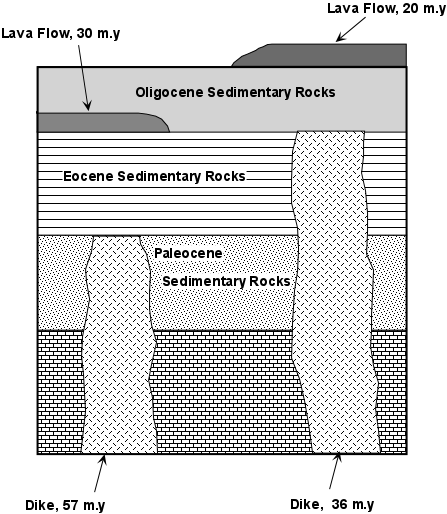
Using the methods of absolute dating, and cross-cutting relationships of
igneous rocks, geologists have been able to establish the absolute times
for the geologic column. For example, imagine some cross section
such as that shown here.From the cross-cutting relationships and
stratigraphy we can determine that:
- The Oligocene rocks are younger than the 30 m.y old lava flow and older than the 20 m.y. old lava flow.
- The Eocene rocks are older than the 57 m.y. old dike and younger than the 36 m.y. old dike that cuts through them.
- The Paleocene rocks are older than both the 36 m.y. old dike and the 57 m.y. old dike (thus the Paleocene is younger than 57 m.y.
The Age of the Earth
Theoretically we should be able to determine the age of the Earth by finding and dating the oldest rock that occurs. So far, the oldest rock found and dated has an age of 3.96 billion years. But, is this the age of the Earth? Probably not, because rocks exposed at the Earth's surface are continually being eroded, and thus, it is unlikely that the oldest rock will ever be found. But, we do have clues about the age of the Earth from other sources:
- Meteorites - These are pieces of planetary material that fall from outer space to the surface of the Earth. Most of these meteorites appear to have come from within our solar system and either represent material that never condensed to form a planet or was once in a planet that has since disintegrated. The ages of the most primitive meteorites all cluster around 4.6 billion years.
- Moon Rocks - The only other planetary body in our solar system that we have samples of are moon rocks (samples of Mars rocks have never been returned to Earth). The ages obtained on Moon rocks are all within the range between 4.0 and 4.6 billion years. Thus the solar system and the Earth must be at least 4.6 billion years old.