Earthquakes and Seismic Waves


Earthquakes and Seismic Waves
adapted to HTML from lecturenotes of Prof. Stephen A. Nelson Tulane University
...see
also Earthquakes in self-learning section
What Are Plate Tectonics?
Seismic Zones
Recycling of Crustal Material
What is an earthquake?
What are Seismic Waves?
Magnitude
and Intensity of an Earthquake
Richter Scale for Earthquakes
Modified Mercalli Scale for
Earthquakes
How do earthquakes affect buildings?
How do buildings respond
to earthquakes?
What is liquefaction?
How to
Construct Earthquake Resistant Buildings
Preparing for an Earthquake
What Are Plate Tectonics?
To experience the plate tectonics--the jostling of giant plates that carry continents and oceans--try this experiment:
Hold your hand in front of you and watch you finger nails grow. That is roughly the average speed of a tectonic plate. Even at this slow rate, over time movement can produce dramatic and deadly consequences.
Plate tectonics tells us that the Earth's rigid outer shell, or lithosphere, is broken into a mosaic of oceanic and continental plates which can slide over the plastic aesthenosphere, which is the uppermost layer of the mantle. The plates are in constant motion. Where they interact, along their margins, important geological processes take place, such as the formation of mountain belts, earthquakes, and volcanoes.
The lithosphere covers the whole Earth. Therefore, ocean plates are also involved, more particularly in the process of sea-floor spreading. This involves the midocean ridges which are a system of narrow submarine cracks that can be traced down the center of the major oceans. The ocean floor is being continuously pulled apart along these midocean ridges. Hot volcanic material rises from the Earth's mantle to fill the gap and continuously forms new oceanic crust. The midocean ridges themselves are broken by offsets know as transform faults.
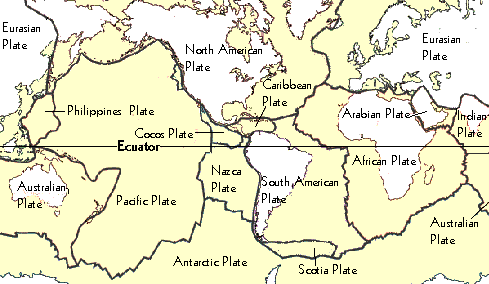
Map of the Earth's Plate Boundaries
Seismic Zones
Plate tectonics revealed that there are four types of seismic zones. The first follows the line of midocean ridges. Activity is low, and it occurs at very shallow depths. The lithosphere is very thin and weak at these boundaries, so the strain cannot build up enough to cause large earthquakes. Associated with this type of seismicity is the volcanic activity along the axis of the ridges (for example, Iceland, Azores, Tristan da Cunha).
The second type of earthquake associated with plate tectonics is the shallow-focus event unaccompanied by volcanic activity. The San Andreas fault is a good example of this. In faults like this, two mature plates are scraping by one another. The friction between the plates can be so great that very large strains can build up before they are periodically relieved by large earthquakes. Although, activity does not always occur along the entire length of the fault during any one earthquake. For instance, the 1906 San Francisco event was caused by breakage only along the northern end of the San Andreas fault.
The third type of earthquake is related to the collision of oceanic and continental plates. One plate is thrust or subducted under the other plate so that a deep ocean trench is produced. This type of earthquake can be shallow, intermediate, or deep, according to its location on the downgoing lithospheric slab. Such inclined planes of earthquakes are know as Benioff zones.
The fourth type of seismic zone occurs along the boundaries of continental plates. Typical of this is the broad swath of seismicity from Burma to the Mediterranean, crossing the Himalayas, Iran, Turkey, to Gilbraltar. Within this zone, shallow earthquakes are associated with high mountain ranges where intense compression is taking place. Intermediate-and deep-focus earthquakes also occur and are known in the Himalayas and in the Caucasus. The interiors of continental plates are very complex, much more so than island arcs. For instance, we do not yet know the full relationship of the Alps or the East African rift system to the broad picture of plate tectonics.
Recycling of Crustal Material
If the Earth was not to be blown up like a balloon by the continual influx of new volcanic material at the ocean ridges, then old crust must be destroyed at the same rate where plates collide. The required balanced occurs when plates collide, and one plate is forced under the other to be consumed deep in the mantle, a process kown as plate subduction.
It is now known that there are seven major crustal plates, subdivided into a number of smaller plates. They are about 80 kilometers thick, all in constant motion relative to one another, at rates varying from 10 to130 millimeters per year.
Their pattern is neither symmetrical nor simple. As more and more are learned about the major plates; many complicated and intricate maneuvers are taking place.
We know that most large-scale geological action--such as the formation of mountains, rift valleys, volcanoes, earthquakes, faulting--is due to different types of interaction at plate boundaries.
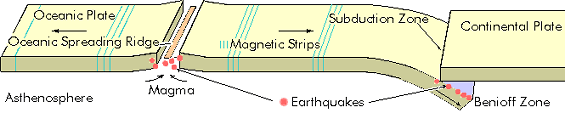
Plate Tectonic Interactions
The Relationship between Plate Tectonics and Earthquakes
The Earth is formed of several layers that have very different physical and chemical properties. The outer layer, which averages about 70 kilometers in thickness, consists of about a dozen large, irregularly shaped plates that slide over, under and past each other on top of the partly molten inner layer. Most earthquakes occur at the boundaries where the plates meet. In fact, the locations of earthquakes and the kinds of ruptures they produce help scientists define the plate boundaries. There are three types of plate boundaries: spreading zones, transform faults, and subduction zones
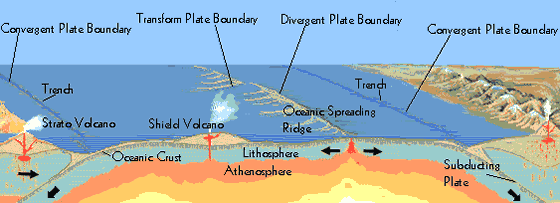
Cross section of the Earth's Plate Tectonic Structure
At spreading zones, molten rock rises, pushing two plates apart and adding new material at their edges. Most spreading zones are found in oceans; for example, the North American and Eurasian plates are spreading apart along the mid-Atlantic ridge.
Spreading zones usually have earthquakes at shallow depths (within 30 kilometers of the surface).
Transform faults are found where plates slide past one another. An example of a transform-fault plate boundary is the San Andreas fault, along the coast of California and northwestern Mexico. Earthquakes at transform faults tend to occur at shallow depths and form fairly straight linear patterns.
Subduction zones are found where one plate overrides, or subducts another, pushing it downward into the mantle where it melts. An example of a subduction-zone plate boundary is found along the northwest coast of the United States, western Canada, and southern Alaska and the Aleutian Islands. Subduction zones are characterized by deep-ocean trenches, shallow to deep earthquakes, and mountain ranges containing active volcanoes. Earthquakes can also occur within plates, although plate-boundary earthquakes are much more common. Less than 10 percent of all earthquakes occur within plate interiors.
As plates continue to move and plate boundaries change over geologic time, weakened boundary regions become part of the interiors of the plates. These zones of weakness within the continents can cause earthquakes in response to stresses that originate at the edges of the plate or in the deeper crust.
What is an earthquake?
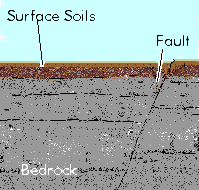
An earthquake is the vibration, sometimes violent, of the Earth's surface that follows a release of energy in the Earth's crust. This energy can be generated by a sudden dislocation of segments of the crust, by a volcanic eruption, or even by manmade explosions.
But the most common kind of quakes, the most destructive and the kind people generally have in mind when we think of earthquakes are the ones that are caused by the sudden dislocation of large rock masses along the faults within the earth's crust. These are known as tectonic earthquakes. A fault is a fracture within some particular rocky mass within the earth's crust.
Fault sizes can vary greatly, as some faults can be miles long. Earthquakes are caused by active faults, which are, faults along which the two sides of the fracture move with respect to each other.
In short, an earthquake is caused by the sudden movement of the two sides of a fault with respect to another.
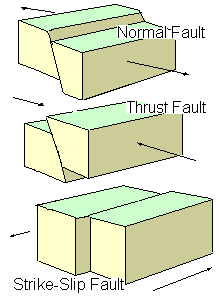
There are three different groups of faults, depending on the way they move (refer to diagram):
- Normal faults
These occur in response to pulling or tension: the overlying block moves down the dip of the fault plane.
- Thrust (reverse) faults
These occur in response to squeezing or compression: the overlying block moves up the dip of the fault plane.
- Strike-slip (lateral) faults
These occur in response to either type of stress: the blocks move horizontally past one another.
The slow and continuous movement of two sides of an active fault relative to one another can noticed over time; this movement is called fault slip. The rate of this movement may be as little as a few inches or so per year. The movement of these two sides of the fault cannot be an entirely smooth, easy type of movement. We can infer the existence of conditions or forces deep with the fault which resist this relative motion of the two sides of the fault. This is because the motion along the fault is accompanied by the gradual buildup of elastic strain energy within the rock along the fault. The rock stores this strain like a giant spring being slowly tightened.
Eventually, the strain along the fault becomes too much for the rock to bear. The fault then ruptures, or suddenly moves a comparatively large distance in a short amount of time. The rocky masses which form the two sides of the fault then snaps into a new position. This snapping back into position, upon the release of strain, is the elastic rebound.
The rupture of the fault also results in the sudden release of the strain energy that had been built up over the years. The most important form that this suddenly released energy takes is that of seismic waves.
What are Seismic Waves?
Seismic energy travels through the crust in the form of waves. There are two basic kinds of seismic waves: body waves and surface waves. Body waves travel outward in all directions, including downward, from the quake's focus -- that is, the particular spot where the fault first began to rupture. Surface waves, by contrast, are confined to the upper few hundred miles of the crust. They travel parallel to the surface, like ripples on the surface of a pond. They are also slower than body waves.
P-waves
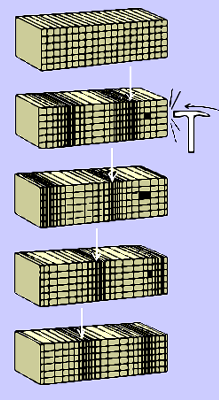
Following an earthquake, the body waves strike first. The fastest kind are the primary waves, or P-waves. People often report a sound like a train just before they feel a quake, which is the P-wave moving as an acoustic wave in the air. P-waves can travel through solids, liquids and gases. When these waves travel throught the air, it is called sound waves. In most rocks, p-waves will travel about 1.7 and 1.8 times faster than the secondary, or S-waves.
S-waves
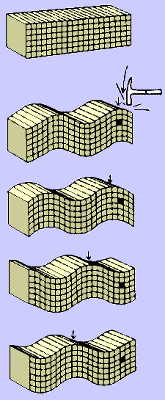
A person in a building perceives the arrival of S-waves as a sudden powerful jolt, as if a giant has pounded his fist down on the roof. Finally, the surface waves strike. In very strong earthquakes, the up-and-down and back-and-forth motions caused by surface waves can make the ground appear to roll like the surface of the ocean, and can literally topple buildings over.
This wave can only travel through solids, and do no travel through the earth's core.
The picture below shows how an S wave travels by vibrating up and down. The black box shows how an area of rock deforms as the wave passes. The hammer represents the initial release of energy at fault rupture
Magnitude and Intensity of an Earthquake
The Richter Magnitude Scale
Seismic waves are the vibrations from earthquakes that travel through the Earth; they are recorded on instruments called seismographs. Seismographs record a zig-zag trace that shows the changing amplitude of ground oscillations beneath the instrument. Sensitive seismographs, which greatly magnify these ground motions, can detect strong earthquakes from sources anywhere in the world. The time, location, and magnitude of an earthquake can be determined from the data recorded by seismograph stations. The richter scale was developed as a mathematical device to compare the size of eathquakes.
The magnitude of an earthquake is determined from the logarithm of the amplitude of waves recorded by seismographs. On the Richter Scale, magnitude is expressed in whole numbers and decimal fractions. For example, a magnitude of 5.0 might be computed for a moderate earthquake, and a strong earthquake might be rated as magnitude 6.0. Each whole number increase in magnitude represents a tenfold increase in measured amplitude; as an estimate of energy, each whole number step in the magnitude scale corresponds to the release of about 31 times more energy than the amount associated with the preceding whole number value.
The Richter Scale is not used to express damage. An earthquake in a densely populated area which results in many deaths and considerable damage may have the same magnitude as a shock in a remote area that does nothing more than frighten the wildlife. Large-magnitude earthquakes that occur beneath the oceans may not even be felt by humans. Earthquakes with magnitude of about 2.0 or less are usually called microearthquakes; they are not commonly felt by people and are generally recorded only on local seismographs. Events with magnitudes of about 4.5 or greater--there are several thousand such shocks annually--are strong enough to be recorded by sensitive seismographs all over the world. Great earthquakes, such as the 1964 Good Friday earthquake in Alaska, have magnitudes of 8.0 or higher. On the average, one earthquake of such size occurs somewhere in the world each year.
The Modified Mercalli Intesity Scale
The effect of an earthquake on the Earth's surface is called the intensity. The intensity scale consists of a series of certain key responses such as people awakening, movement of furniture, damage to chimneys, and finally--total destruction. The current intensity scale being used in the U.S. is the Modified Mercalli (MM) Intensity Scale.
The scale is composed of 12 increasing levels of intensity that range from imperceptible shaking to catastrpic destruction. This scale does not have a mathmatical basis, instread it is an arbitrary ranking system based on observed effects.
The following is an abbreviated description of the 12 levels of Modified Mercalli intensity (MMI).
I.
Not felt except by a very few under especially favorable conditions.
II.
Felt only by a few persons at rest, especially on upper floors of buildings.
Delicately suspended objects may swing.
III.
Felt quite noticeably by persons indoors, especially on upper floors of buildings.
Many people do not recognize it as an earthquake.
Standing motor cars may rock slightly.
Vibration similar to the passing of a truck. Duration estimated.
IV.
Felt indoors by many, outdoors by few during the day.
At night, some awakened.Dishes, windows, doors disturbed; wallsmake cracking sound.
Sensation like heavy truck striking building. Standing motor cars rocked noticeably.
V.
Felt by nearly everyone; many awakened.
Some dishes, windows broken. Unstable
objects overturned. Pendulum clocks may stop.
Vl.
Felt by all, many frightened.
Some heavy furniture moved; a few instances of fallen plaster. Damage slight.
Vll.
Damage negligible in buildings of good design and construction;
slight to moderate in well-built ordinary structures; considerable damage in poorly built
or badly designed structures; some chimneys broken.
Vlll.
Damage slight in specially designed structures; considerable damage in ordinary
substantial buildings with partial collapse. Damage great in poorly built structures.
Fall of chimneys, factory stacks, columns, monuments, walls. Heavy furniture overturned.
IX.
Damage considerable in specially designed structures; well-designed frame structures
thrown out of plumb. Damage great in substantial buildings, with partial collapse.
Buildings shifted off foundations.
X.
Some well-built wooden structures destroyed; most masonry and frame structures
destroyed with foundations. Rails bent.
Xl.
Few, if any (masonry) structures remain standing. Bridges destroyed.
Rails bent greatly.
Xll.
Damage total. Lines of sight and level are distorted. Objects thrown into the air.
How do earthquakes affect buildings?
The dynamic response of the building to earthquake ground motion is the most important cause of earthquake-induced damage to buildings. Ground and soil failure beneath buildings is also a major cause of damage.
The sudden movement along the plane of faults within the earth's crust releases enormous amount energy. This energy then travels through the earth by seismic waves. The waves will travel great distances before losing it's energy.
After the generation of the waves, it will reach the earth's surface and set it in motion, which is refered to as, earthquake ground motion. When the earthquake ground motion occurs beneath the building and is strong enough, it will tranfer the waves and set the building into motion as well. It starts with the building's foundation and then to the rest of the building creating damages along the way.
Ground Motion And Building Frequencies
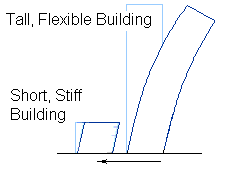
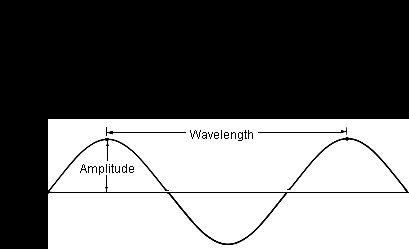
The most important characteristics of earthquake ground motions for buildings are the duration, amplitude (of displacement, velocity and acceleration) and frequency of the ground motion. Frequency is the number of complete cycles of vibration made by the wave per second. We can consider a complete vibration to be be the same as the distance between one crest of the wave and the next, in other words one full wavelength. Frequency is often measured in units called Hertz. If two full waves pass in one second, the frequency is 2 hertz (abbreviated as 2 Hz).
Response of the building to ground motion is as complicated as the ground motion itself, yet typically quite different. It also begins to vibrate in a complex manner, and because it is now a vibratory system, it also possesses a frequency content. However, the building's vibrations tend to center around one particular frequency, which is known as its natural or fundamental frequency. So the shorter a building is, the higher its natural frequency. The taller the building is, the lower its natural frequency.
Building Frequency and Period
Another way to understand this is to think of the building's response in terms of it's natural period. The building period is simply the inverse of the frequency: Whereas: the frequency is the number of times per second that the building will vibrate back and forth, the period is time it takes for the building to make one complete vibration.
The relationship between
frequency f
and theperiod T
is:T = 1 / f
This means that a short building with a high natural frequency also has short natural period. A very tall building with a low frequency has a long period. For example, it takes the Empire State Building a comparatively long time to sway back and forth during a strong gust of wind.
How do buildings respond to earthquakes?
The absolute movement of the ground and building during an earthquake is all that large at all, even during a major earthquake.
That means that the building does not undergo displacements that are large compared to the building size itself. So it is not the distance that the building moves that causes damage, instead, it is more of the sudden force that causes the building to shift quickly that causes the building to suffer damage. Think of someone pulling a rug from beneath you. If they pull it quickly (i.e., accelerate it a great deal), then they dont have to pull it very far to throw you off balance. On the other hand, if they pull the rug slowly and gradually increase the speed of the rug, they can move (displace) it and you a great distance without that same unfortunate result.
In other words, the damafe that a building suffers is not because of its displacement, but upon acceleration. Whereas displacement is the actual distance the ground and the building may move during an earthquake, acceleration is a measure of how quickly they change speed as they move. During an earthquake, the speed at which both the ground and building are moving will reach some maximum. The more quickly they reach this maximum, the greater their acceleration.
Newton's Law
Acceleration has this important influence on damage, because, as an object in movement, the building obeys Newton' famous Second Law of Dynamics. The simplest form of the equation which expresses the Second Law of Motion is:
F = m a
This states the Force acting on the building is equal to the Mass of the building times the Acceleration. So, as the acceleration of the ground, and in turn, of the building, increase, so does the force which affects the building, since the mass of the building doesn't change.Of course, the greater the force affecting a building, the more damage it will suffer; decreasing Fis an important goal of earthquake resistant design. When designing a new building, for example, it is desirable to make it as light as possible, which means, of course, that M,and in turn ,Fwill be lessened. There are also various techniques now for reducing A.
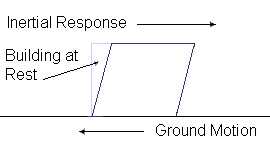
Inertial Forces
It is important to know that Fis actually what's known as an inertial force, that is, the force created by the building's tendency to remain at rest, and in its original position, even though the ground beneath it is moving. This is in accordance with another important physical law known as D'Alembert's Principle, which states that a mass acted upon by an acceleration tends to oppose that acceleration in an opposite direction and proportionally to the magnitude of the acceleration (see picture above). This inertial force F imposes strains upon the building's structural elements. These structural elements primarily include the building's beams, columns, load-bearing walls, floors, as well as the connecting elements that tie these various structural elements together. If these strains are large enough, the building's structural elements suffer damage of various kinds.
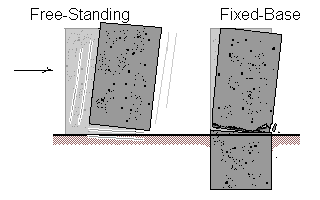
To help you understand the concept and process of inertial generated strains, consider this example. Imagine a simple block of stone that is perfectly rigid. During an earthquake, if this block is simply sitting on the ground without any attachment to it, the block will move freely in a direction opposite to the ground motion, with a force proportional to the mass and acceleration of the block. If the same block, however, is solidly founded in the ground and no longer able to move freely, it must in some way absorb the inertial force internally. In the picture to the right, this internal uptake of force is shown to result in cracking near the base of the block .
Building Stiffness
The taller a building, the longer its natural period tends to be. But the height of a building is also related to another important structural characteristic: the building's flexibility. Taller buildings tend to be more flexible than short buildings. (consider a thin metal rod. If it is very short, it is difficulty to bend it in your hand. If the rod is somewhat longer, and of the same diameter, it becomes much easier to bend. Buildings behave similarly.) So we conclude that a short building is a stiff, while a taller building is flexible.
Stiffness greatly affects the building's uptake of earthquake generated force. Reconsider the example above, of the rigid stone block deeply founded in the soil. The rigid block of stone is very stiff; as a result responds in a simple, dramatic manner. Real buildings, of course, are more inherently flexible, being composed of many different parts.
Furthermore, not only is the block stiff, it is brittle; and because of this, it cracks during the earthquake. This leads us to the next important structural characteristic affecting a building's earthquake response and performance: ductility.
Ductility
Ductility is the ability to undergo distortion or deformation--bending, for example-- without resulting in complete breakage or failure. The ductility or flexability of structure is one of the most important factors affecting its earthquake performance. One of the primary tasks of an engineer designing a building to be earthquake resistant is to ensure that the building will possess enough ductility to withstand the size and types of earthquakes it is likely to experience during its lifetime. Damping
All vibrating objects, including buildings, will eventually stop vibrating as time goes on. More precisely, the amplitude of vibration decays with time. Without damping, a vibrating object would never stop vibrating, once it had been set in motion. In a building during an earthquake, damping--the decay of the amplitude of building's vibrations--is due to internal friction and the absorption of energy by the building's structural and nonstructural elements. All buildings have some intrinsic damping. The more damping a building possesses, the sooner it will stop vibrating--which of course is better. Today, some of the more advanced techniques of earthquake resistant design and construction employ added damping devices like shock absorbers to increase artifically the intrinsic damping of a building and so improve its earthquake performance.
What is liquefaction?
Liquefaction is a type of ground failure. This happens when loose, moist soil or sand is shaken so hard that individual grains separate, turning the earth into a soft, fluid slurry that can swallow entire buildings. And ground motions in regions of soft sediment are drastically amplified relative to surrounding areas, so that much greater earthquake damage results, such as that in the Marina District of San Francisco following the 1906 and Loma Prieta (1989) earthquakes. During the Loma Prieta earthquake, liquefaction of the soils and debris used to fill in a lagoon caused major subsidence, fracturing, and horizontal sliding of the ground surface in the Marina district in San Francisco
How to Construct Eqrthquake Resistant Buildings
>Fig.1 The conventional approach to earthquake resistant design of buildings depends on providing the building with strength, stiffness and inelastic deformation capacity which are strong enough to withstand a given level of earthquake-generated force. This is generally accomplished through the selection of an appropriate structural configuration and the careful detailing of structural members, such as beams and columns, and the connections between them.
But in contrast, we can say that the basic approach to more advanced techniques for earthquake resistance is not to strengthen the building, but to reduce the earthquake-generated forces that is put on the building. The most important advanced techniques of earthquake resistant design and construction are:
-
- Base Isolation Energy
- Dissipation Devices Active Control Systems
This is the most widely used method against earthquake damage. A base isolated structure is supported by a series of bearing pads which are placed between the building and the building's foundation. (See Figure 1). A variety of different types of base isolation bearing pads have now been developed, including ones called lead-rubber bearings.
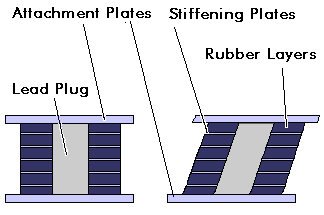
Fig.2 A lead-rubber bearing is made from layers of rubbers sandwiched together with layers of steel. In the middle of the bearing is a solid lead "plug." On top and bottom, the bearing is fitted with steel plates which are used to attach the bearing to the building and foundation. (See Figure 2) The bearing is very stiff and strong in the vertical direction, but flexible in the horizontal direction.
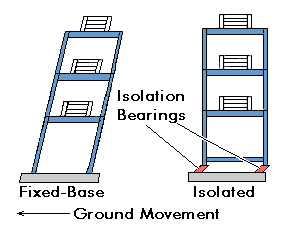
Fig. 3 shows how this isolation system works. As a result of an earthquake, the ground beneath each building begins to move. In Figure 3, it is shown moving to the left. Each building is undergoing displacement towards the right, which is due to inertia.In addition to displacing to the right, the un-isolated building is also changing shape into more of a parallelogram from a rectangular. This is the process if deforming. And of course, the primary cause of earthquake damage is deformation which the building goes through as a result of inertial force acting on it.
The base-isolated building, though is still displacing, retained it's original retangular shape. Only the lead-rubber bearing supporting the building are deformed. The base-isolated building escaped the deformation and damage--which shows that the inertial forces acting on the base-isolated building have been reduced. Experiments and observations of base-isolated buildings in earthquakes have been shown to reduce building accelerations to as little as 1/4 of the acceleration of fixed-base buildings Since the rubber isolation bearings are highly elastic, they don't suffer any damage. The lead plug in the middle of the example bearing experiences the same deformation as the rubber. However, it also generates heat as it does so. In other words, the lead plug reduces, or dissipates, the energy of motion--i.e., kinetic energy--by converting that energy into heat. And by reducing the energy entering the building, it helps to slow and eventually stop the building's vibrations sooner--in other words, it damps the building's vibrations.
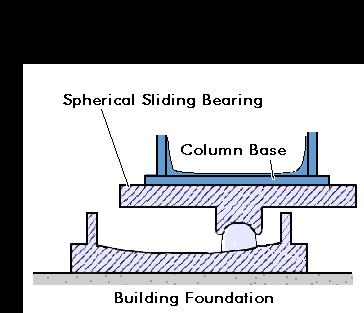
Fig.4 A second type of base-isolation is called Spherical Sliding Isolation Systems. With this, the building is supported by bearing pads that have a curved surface and low friction. During an earthquake, the building is free to slide on the bearings. Since the bearings have a curved surface, the building slides both horizontally and vertically (See Figure 4). The force needed to move the building upwards limits the horizontal or lateral forces which would otherwise cause building deformations. Also, by adjusting the radius of the bearing's curved surface, this property can be used to design bearings that also lengthen the building's period of vibration.
Preparing for an Earthquake
Practice Drills
By planning and practicing what to do in case of an earthquake, your family can learn to react correctly and automatically when the shaking begins. During an earthquake, most deaths and injuries are caused by collapsing building materials and heavy falling objects, such as bookcases, cabinets, and heating units. Learn the safe spots in each room of your home.
Participating in an earthquake drill will help children understand what to do in case you are not with them during an earthquake.
During your earthquake drill:
- Get under a sturdy table or desk and hold on to it.
- If you're not near a table or desk, cover your face and head with your arms; and
- stand or crouch in a strongly supported doorway OR . . .
- brace yourself in an inside corner of the house or building.
- Stay clear of windows or glass that could shatter or objects that could fall on you.
Remember: If inside, stay inside. Many people are injured at entrances of buildings by falling debris.
Indicate the location of your family's emergency outdoor meeting place. Write Down Important Information
Make a list of important information and put it in a secure location. Include on your list:
radio and television broadcast stations to tune to for emergency broadcast information Gather and Store Important Documents in a Fire-Proof Safe
- Birth certificates
- Ownership certificates (automobiles, boats, etc.)
- Social Security cards
- Insurance policies
- Wills
- Household inventory, including:
- list of contents
- photographs of contents of every room
- photographs of items of high value, such as jewelry, paintings, collectors' items